Justin Langer: How the Dalai Lama and two missed calls taught me to fight for change

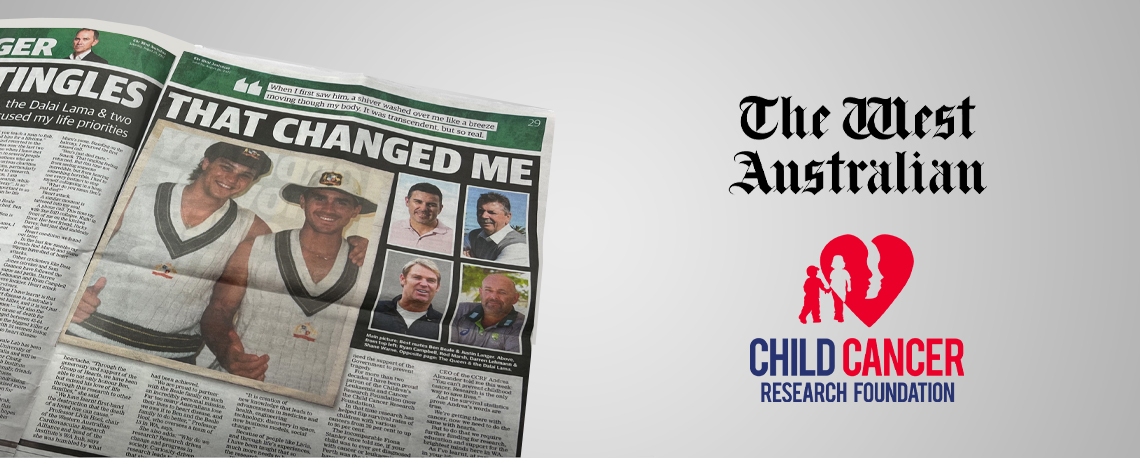
Source: The West Australian, Saturday 20 August – Page 28-20
Author: Justin Langer

Rarely does a person walk into your presence and make every cell in your body tingle. It’s happened twice in my life. The first was meeting the Queen at Buckingham Palace in 1997. An incredible moment. Maybe a story for another day.

The second was a mystical experience that is hard to intellectualise, but it was so real it took my breath away. Sitting on a Qantas flight, a stewardess asked if I would mind moving back a few rows. After shifting seats, four of the toughest, but oddly serene looking men walked on to the plane. Next thing, His Holiness the Dalai Lama is sitting two seats in front of me. When I first saw him, a shiver washed over me like a breeze moving though my body. It was transcendent, but so real.

A few days later a friend, Graham Laitt, invited me to an event run by the Australia-Israel Chamber of Commerce, to listen to the Dalai Lama speak. Not only was I invited, but I was one of only two people chosen to ask His Holiness a question of my choosing. What do I ask a man who had such a profound impact on me only a few days before? A man who I had also read about and used as a valuable resource though my life-long journey of meditation.

Nervous as I had ever been in my life, the question I settled on was: “In this world we live in, with so many incredible causes and charities, how do we decide where to spend our time, service and resources?”

His answer, after pondering for a moment or two, was: “Education is the strongest form of charity.”

In a nutshell, it reminded me of, “If you give a man a fish, you feed him for a day. If you teach a man to fish, you feed him for a lifetime.”

My mind reverted to the Dalai Lama over the last two weeks or so when I have met and spoken to several people and organizations who are involved in various charities and foundations, particularly those dedicated to research. Like education, I am learning that research, while not necessarily “sexy”, is so fundamentally important to so many areas that can be life changing.

This week the Ben Beale Laboratory was launched. Ben was my best friend. I say “was” because Ben is no longer with us. Like seeing the Dalai Lama, I will never forget the moment in 2017 when I heard about Ben’s death. I was literally following a doctor up the stairs into my ailing Mum’s bedroom. He was just about to talk to our family about how palliative care was going to work. Mum had ovarian cancer and was in her last stages of her life. But when walking up the stairs, my phone pinged twice in 10 seconds. Hhmmm, strange, two messages from two close mates. As desperate as the communication was from the doctor about my beautiful Mum, I decided to turn left instead of veering right into Mum’s room. Standing on the balcony, I returned the first missed call.

“Ben’s just died mate.”

Smack. That tingling feeling returned. But this time not from seeing someone incredible, but from hearing something horrible. I had to use every instinct to stop myself collapsing in a heap.

“What do you mean Ben’s just died?”

Heart attack.

A similar moment is tattooed into my soul. A phone call. This time my wife Sue DID collapse. Right in front of me on the kitchen floor. Her best friend, Nicky Davey, had just died suddenly aged 36. Heart condition we found out later.

In the last few months my friends Rod Marsh and Shane Warne have died of heart attacks. Other cricketers like Dean Jones (stroke) and Sam Gannon have followed the same sad paths. Darren Lehmann and Ryan Campbell were luckier. Heart attack survivors. What I have learnt is that heart disease is Australia’s biggest killer, and it is not just older men — but also the leading cause of death for people aged between 45-64. It’s also the biggest killer of women, with 24 women losing their lives to heart disease every day.

The Ben Beale Lab has been set up at the University of Western Australia and will be run by the Victor Chang Cardiac Research Institute. Supported by family, friends and generous business associates, the fundraising campaign has raised more than $1.8 million for heart research. Ben’s wife Sarah, who has driven this legacy, says she hopes it will prevent other families from suffering unnecessary heartache.

“Through the generosity and support of the Group of Hearts, we have been able to not only honour Ben, but extend his love of life through this research to other families,” she said.

“We have learnt first-hand the destruction that the death of a loved one can cause.”

Professor Livia Hool, chair of the Western Australian Cardiovascular Research Alliance and head of the institute’s WA hub, says she was humbled by what had been achieved.

“We are proud to partner with the Beale family on such an incredibly personal mission. Far too many Australians lose their lives to heart disease, and we owe it to Ben and the Beale family to do better,” Professor Hool, who oversees a team of 13 in WA, says.

She also adds: “Why do we research? Research drives change and progress in society. Curiosity-driven research leads to discoveries that shape a civilised society.

“It is creation of new knowledge that leads to advancements in medicine and health, engineering technology, discovery in space, new business models, social change.”

As I’ve learnt, at rare points in your life something will make your body tingle.

Because of people like Livia, and through life’s experiences, I have been taught that so much more needs to be done in the research space. Philanthropy is crucial, but in many instances it simply isn’t enough. These incredible doctors and researchers also need the support of the Government to prevent tragedy.

For more than two decades I have been proud patron of the Children’s Leukaemia and Cancer Research Foundation (now the Child Cancer Research Foundation). In that time research has helped flip survival rates of children with various cancers from 20 per cent to up to 95 per cent.

The incomparable Fiona Stanley once told me, if your child was to ever get diagnosed with cancer or leukaemia, Perth was the place for it to happen. She said it with humility and compassion, but also with such authority that I now forever feel hope for those innocent souls who have their lives turned upside down by those fateful words, “You have cancer”.

CEO of the CCRF Andrea Alexander told me this week: “You can’t prevent childhood cancer. Research is the only way to save lives.”

And the survival statistics prove Andrea’s words are true.

We’re getting there with cancer, now we need to do the same with hearts. But to do that we require further funding for research, education and support for the brightest minds here in WA. As I’ve learnt, at rare points in your life something will make your body tingle. For me, it’s been meeting people like the Queen and the Dali Lama, and through shock personal experiences like Ben and Nicky passing away. Hopefully, if and when it happens again, it will be from meeting, not losing, someone who is incredible.
 

CCRF wins Grill’d Local Matters

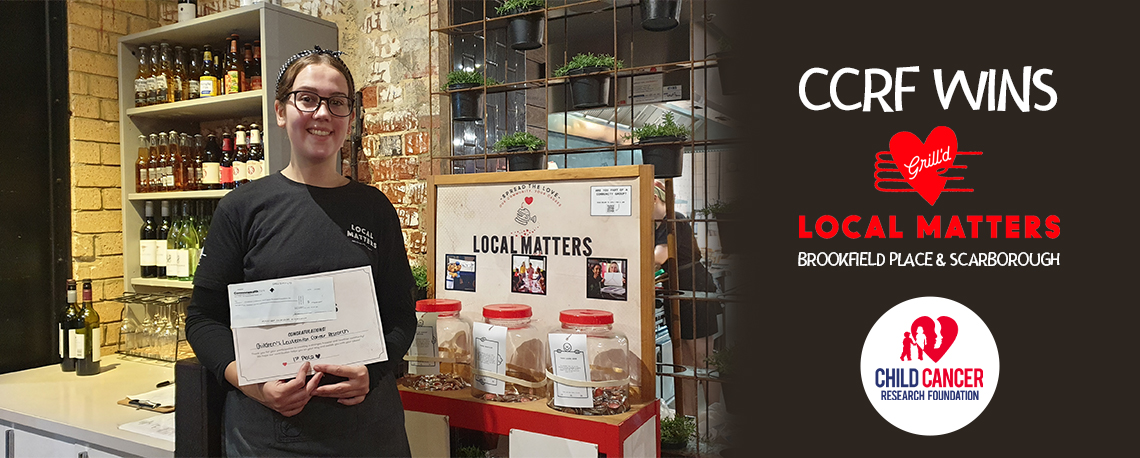
Thanks to the help of the generous local community, our Foundation has won two more Grill’d Local Matters campaigns! Our Foundation was recently included in the Local Matters program at Grill’d Brookfield Place and Grill’d Scarborough, where we received the most votes in both jars by the end of the respective months.

With winning Local Matters jars receiving $300, our Foundation has received a donation of $600 from Grill’d! Local Matters tokens are given out to customers with every burger purchase, where they have a choice between three jars representing three different causes. We thank every single person who decided to put their token in our jar.

A big thank you to Grill’d Brookfield Place and Grill’d Scarborough for selecting us to participate in this incredible initiative that gives back to the community. We look forward to the chance of participating in another Local Matters campaign soon.

Whether you’re a vegetarian, vegan, gluten free, or all in, there is sure to be something for you on the mouth-watering Grill’d menu. If you’re looking for a fresh and healthy burger, we recommend checking out the amazing team at Grill’d Brookfield Place or Scarborough. Or simply head to the Grill’d website to find a restaurant near you.

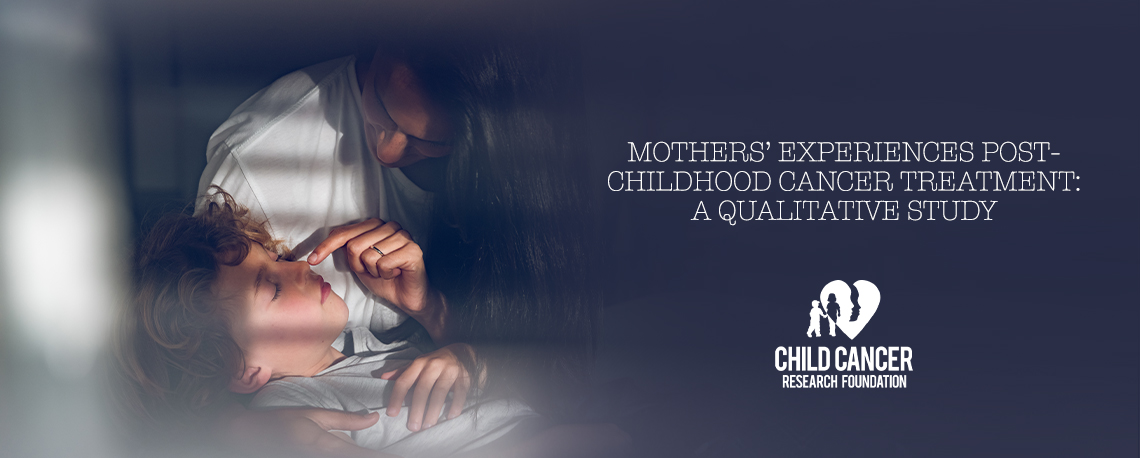
Mothers’ Experiences Post-Childhood Cancer Treatment: A Qualitative Study

Jenny Davies is a great friend of the Foundation who is currently completing her PhD in Psychology at Curtin University, exploring the impact of childhood cancer on families. This is a topic that hits close to home for Jenny, with her daughter Amelia having battled childhood cancer when she was 12 years old.

Determined to use their experience to help others, Amelia was inspired to study medicine while Jenny pursued a PhD. On 10 August 2022, Jenny’s honours research was published in the Journal of Child and Family Studies, a peer-reviewed academic journal.

Jenny’s research is a qualitive study on Mothers’ Experiences Post-Childhood Cancer Treatment. The study highlights that the stress and anxiety that comes with a child’s cancer diagnosis does not finish at the end of treatment. Mothers, in fact, experience long-term ramifications.

Some of the key takings from Jenny’s research includes:

  • After treatment mothers must adjust to new identities as mothers of children who have been diagnosed with cancer.
  • Fear of relapse and late effects makes it difficult for mothers to develop a new narrative for their children and themselves.
  • Mothers felt guilt and regret about impact of childhood cancer on siblings and this guilt did not dissipate after end of treatment.
  • There is a need for more practical and psychological support tailored to mothers’ individual needs.

We congratulate Jenny on this wonderful achievement and we thank her for her important work. We highly recommend having a look at Jenny’s research paper to gain a better understanding of how a childhood cancer diagnosis effects the whole family.

Read more

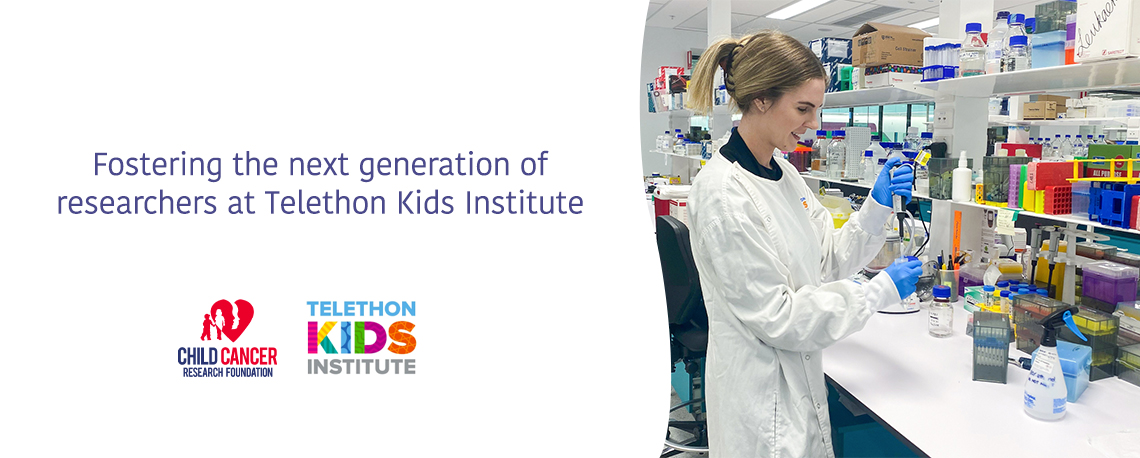
Fostering the next generation of researchers at Telethon Kids Institute

One of the great things about the research projects that CLCRF funds is the opportunity to foster the next generation of researchers. The Telethon Kids Institute has around 100 students enrolled from several universities around Australia, conducting research projects from laboratory-based projects to population-wide studies.

We recently met with Taylor Ferguson, a Curtin University student who has commenced the first year of her PhD in Associate Professor Rishi Kotecha and Dr Laurence Cheung’s Leukaemia Translational Research laboratory. Taylor is continuing her studies from last year, where she completed her Honours degree alongside the respected researchers.

As part of this team, Taylor has been looking at a specific subtype of leukaemia, which has a rearrangement of the KMT2A gene and is associated with a poor prognosis. “Previously, my lab did a large drug screen to identify some novel agents that could be used,” said Taylor. “So, my project is to further investigate these novel agents in detail and move them forward in the preclinical setting.” The ultimate goal is for these novel agents to be translated into clinical trials.

Confessing that this was the only Honours project she applied for, Taylor had her heart set on the opportunity to help make a difference for future generations of children. “I did a mini research project at university which was to do with infants,” Taylor explained. “This drew my attention as to how vulnerable they are, especially to the side effects of chemotherapies. So, when I saw this project, I decided that it would be something I’d be interested in, to work towards improving outcomes for these infants.”

The prognosis of infants diagnosed under the age of one with KMT2A-rearranged acute lymphoblastic leukaemia is poor, with a 5-year event-free survival rate of less than 40%. “Because they are babies, they don’t have the ability to tolerate the chemotherapies the same way that older people might be able to,” explained Taylor. “So, if you’re trying to reduce the leukaemia disease burden, you have to increase the intensity of the chemotherapy. Unfortunately, babies can’t tolerate these high doses.”

There is a significant need to find new therapies to improve outcomes for these babies, which can only come with more funding. “Just to give these babies a fighting chance, especially those with this aggressive gene rearrangement, is the reason why extra funding is needed.”

When asked what her favourite thing about her job has been so far, Taylor stated that she has enjoyed becoming part of a team. “At university, it’s very much everyone for themselves and you do your own work,” she explained. “But in this team environment, you realise everyone is working towards a common goal. And so, it’s like a little community. Everyone wants to improve the outcomes for children with cancer, and specifically in my team, it’s for infants with leukaemia.”

Although now finding her feet in research, Taylor did not always know that this was the work she wanted do. “I kind of went through every career that I possibly could. When I first went to university, I wasn’t quite sure what I wanted to do. The more I got into science, the more I decided how much I loved it. And research is like focused science in a specific area. You also have outcomes that you can build off, and which other people can use to improve treatments or therapies.”

Grateful to be placed in this role, Taylor expressed how lucky she feels to be at the Telethon Kids Institute. “It’s a very good environment and the team that I have is just amazing,” she said. “Everyone’s been very supportive, and they all help me whenever I need it, which, at the beginning was a lot.”

Taylor explained that she would love to stay in the realm of leukaemia research. “I really enjoy the work,” she said. “It’s such a horrible disease, if there’s anything I can do to contribute to the research for it, that’s the research I want to do.”

We are delighted to be able to support you­­ng researchers like Taylor as they aim to improve the lives of children with cancer. You can help support Taylor’s research, and give infants with leukaemia a fighting chance by making a donation towards childhood cancer research today. Simply head to www.clcrfgiving.org


Behind the lab coat: 

What do you like to do in your spare time? 

I’m a bit of a homebody. I really enjoy spending time with my family. We moved from Scotland and it’s only the five of us here, so we’re very close.

I like to just relax and just have a good time reading books, going out with friends, things like that. I’m a very simple person.

What’s your favourite genre to read?

I usually read sci-fi or fantasy.

What’s your favourite quote?

My parents always tell me take every opportunity and you only fail if you never tried. They actually say that to me quite a bit.

It’s especially relevant in research, because not everything goes according to plan but you have to keep trying and keep persisting. Resilience is what gets outcomes at the end.

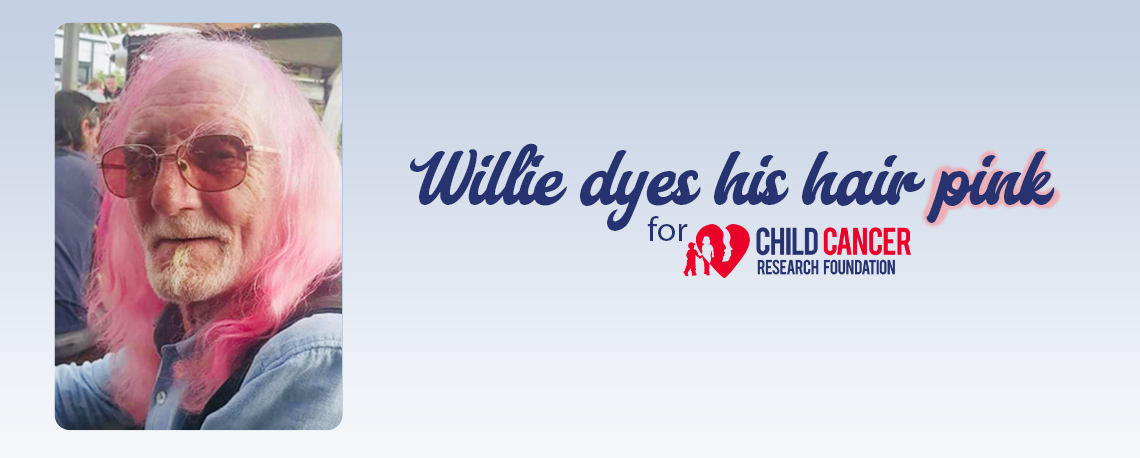
Willie dyes his hair pink for childhood cancer research

The Foundation would like to thank Malcom David Morris (Also known as Willie) for raising $1225 by dying his luscious locks bright pink! Willie is a local legend at The Swinging Pig in Rockingham, where he encouraged the team and patrons to donate whatever they can in a donation tin at the bar.

When asked why Willie decided to support our Foundation, he responded with “I strongly believe every child deserves a future.” Willie also expressed that he didn’t expect to raise as much as he did. “I am very grateful to all those who donated,” he said.

We commend Willie for his fun new hairdo and thank him for choosing to support childhood cancer research, so that more children can live the long and fulfilling lives they deserve. We also thank Sally from The Swinging Pig who we believe was a huge help with Willie’s fundraiser.

If you would like to support childhood cancer research with your own fundraiser, our team would be more than happy to assist you! Simply send an email to [email protected] or call our office on (08) 9363 7400.

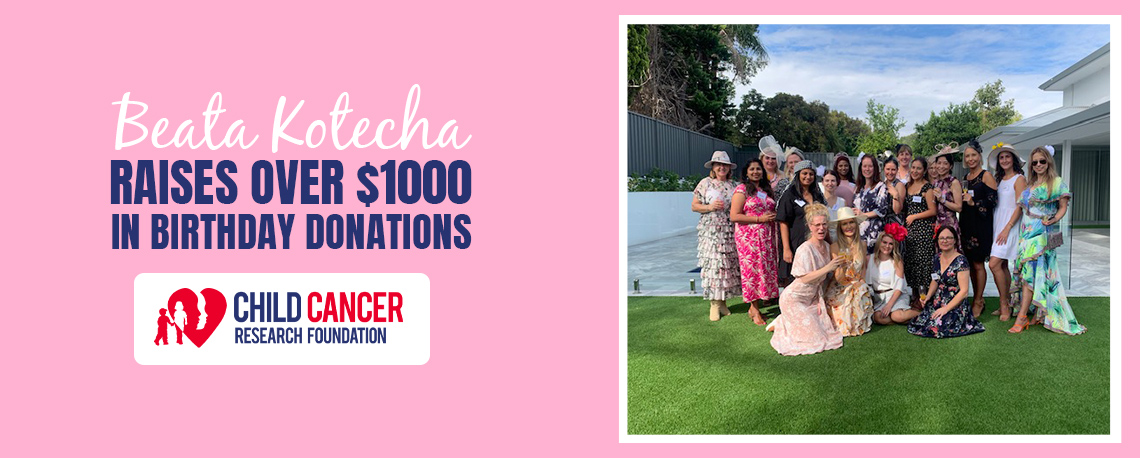
Beata Kotecha raises over $1000 in birthday donations!

Earlier this year, one of our generous supporters Beata Kotecha organised a charity birthday fundraiser for our Foundation. Beata organised a high tea party with her friends where, instead of presents, she asked for donations towards childhood cancer research.

Beata and her friends raised $1070 for the Foundation! “Since I’ve seen how much good work your Foundation is doing, I wish to help as much as I can,” expressed Beata. “All of the ladies who attended my high tea were very generous, so I thank all of them.”

There’s no doubt that Beata knows all about the importance of funding the research into childhood cancers, with her husband, Dr Rishi Kotecha, being an acclaimed paediatric oncologist and researcher at the Telethon Kids Institute Cancer Centre.

We are so appreciative of Beata using her birthday to make a difference in the lives of children with cancer. If you have a birthday coming up, consider asking for donations in lieu of presents!

This can be easily done through a Facebook Fundraiser. All you need to do is:

  1. Head to facebook.com/fundraisers
  2. Click “Raise Money” and select “Charity”
  3. Search and select “Children’s Leukaemia & Cancer Research Foundation”
  4. Fill out your fundraiser details and click “create”

Please let us know if you decide to create a birthday fundraiser for our Foundation so we can thank you and help you spread the word! Simply send us a message on Facebook, email us, or call our office on (08) 9363 7400.

Local Immunotherapy

Local Immunotherapy for Sarcoma

Our Foundation has helped fund so many important research projects at the Telethon Kids Institute, working together with the Institute for decades to help improve the lives of children battling cancer. One of the exciting research projects that we are currently helping to fund is the Local Immunotherapy for Sarcoma project, headed by Associate Professor Joost Lesterhuis.

Joost is the Head of the Sarcoma Translational Research team at the Telethon Kids Cancer Centre, a team that aims to discover and develop safer and more effective treatments for sarcoma through inventive and rigorous research. One of the team’s current focuses is on developing immunotherapy approaches for childhood sarcoma that can be applied during surgery to prevent relapse.

Sarcomas are a group of cancers of the bone, muscle, or connective tissue. About 15% of cancers in children and adolescents are sarcomas, whereas it makes up only 1% of cancers in adults. “The biggest problem that has been facing sarcoma is that there hasn’t been a lot of progress in the last three decades,” said Joost. “Basically, we treat children with sarcoma the same as we did three decades ago.”

The relatively high incidence of the disease in children and the regularity of relapse makes the development of more effective treatments a high priority. “We really need to do better,” said Joost. “Because, at the moment, the primary treatment that we have available is surgery. With surgery, you really want to get rid of the tumour with a wide margin around it. Which, in some cases actually means amputations of limbs.”

Unfortunately, in many cases, some cancer cells will remain after surgery, which can then grow out in time and cause the cancer to come back. This means children must also go through harsh chemotherapy or radiotherapy before and after surgery. Even after all this, some children will still relapse.

“Once sarcoma returns, the prognosis becomes rather grim,” explained Joost. “One in three children will actually die from their sarcoma. So, we really have to do better.”

Currently, Joost and his team are developing a gel that can be left behind in the wound bed by the surgeon after sarcoma surgery. Children can then go home while the gel locally releases immunotherapy in the period that follows the surgery.

The aim is for the gel to attract and activate immune cells to mop up any remaining cancer cells, hopefully preventing the relapse of the sarcoma. The nature of the gel itself means that it safely degrades on its own.

This is such an exciting project and one that our Foundation is extremely proud to help fund. By continuing to fund this project, with the help of our generous community of supporters, we can see outcomes improve for so many children with sarcoma.

When you donate towards CCRF, you are helping to support world-class researchers like Joost and his team at the Telethon Kids Cancer Centre. This helps us get closer to seeing a future where children can live the cancer-free and side-effect-free lives that they deserve. If you would like to donate, simply head to our online donation page.

Images provided by Telethon Kids Institute


We're Rebranding

We’re rebranding!

We are thrilled to unveil our fresh new brand identity! Our team has thought long and hard about creating an identity that accurately depicts who we are as an organisation, landing on a brand new name and modified logo.

As our Foundation funds the vital research into all types of childhood cancers, we believe Child Cancer Research Foundation (CCRF) is a better representation of what we do. With “child cancer research” already being our website domain name for many years, it only made sense for this to be reflected in the rest of our brand. The condensed name is also less of a mouthful than the predecessor – so, you’re welcome!

Although our name has changed, our mission certainly has not. We remain committed to ensuring the ground-breaking research into childhood cancers continues, so that future generations of children can live the long and fulfilling lives they deserve.

Our new branding is simply a new trading name for our Foundation, meaning our ABN remains the same and nothing will change in terms of where your donations are going.

These changes will be effective from today, 1 July 2022. As this is quite a significant change for our team, we ask that you please bear with us as make the necessary adjustments across all our online and offline channels.

Whether you are a new or a long-time supporter of our Foundation, we would like to sincerely thank you for your support. We believe, with the help of our restored brand image, our Foundation will only continue to grow and get closer to seeing a cancer-free future for our children.

If you have any queries, please do not hesitate to contact us.

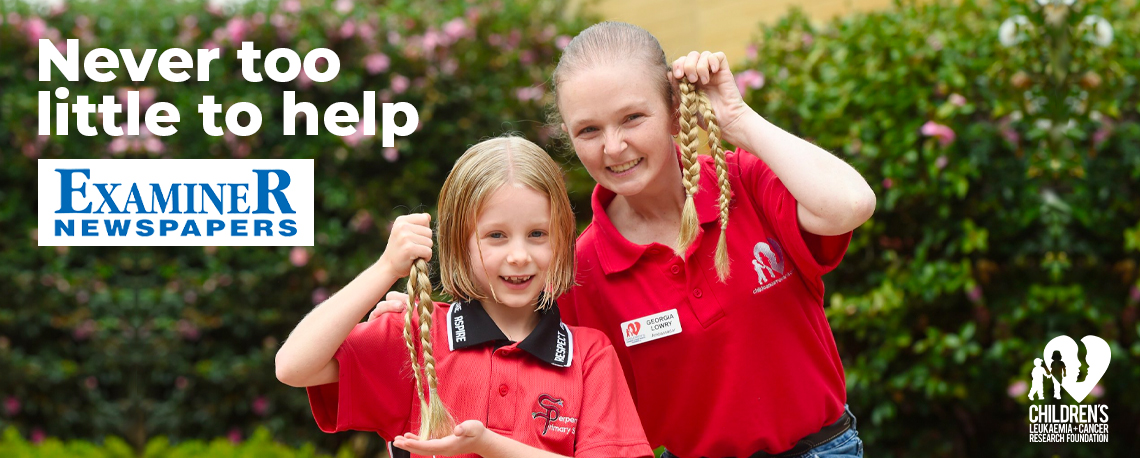
Never too little to help

Source: Serpentine Jarradale Examiner – Issue 1516 • June 30th 2022 – Page 3
Author: Chris Fowler

Photo credit: Richard Polden

A Year 3 student at Serpentine Primary proved you are “never too little to help,” last Thursday, after a hair cut in front of her entire school helped her raise more than $3000 for children with cancer.

Eight-year-old Emilia took to the stage at a special assembly, where hairdressers cut her golden locks, to be donated for use in wigs for people being treated for cancer.

Alongside the haircut, Emilia, with the help of her Mum, Cara, set up a fundraising page on Facebook, that has so far received 78 donations.

While Cara was proud of her daughter’s initiative, she never expected the bright-eyed humanitarian to raise so much in donations.

“I thought $500 would be lovely to donate – $3375 is just gob smacking,” Cara said. Emilia decided to make her fundraising drive after asking her mother about what happens to people’s hair when they receive treatment for cancer.

“She had seen a couple of friends suffering from cancer and asked me last year what happens to people that lose their hair from having cancer,” Cara said.

“I explained why and that they need to wear a wig and she decided then she would donate her hair.

“Our very close family friend is a childhood cancer survivor, so I thought what better way to support the Foundation that supports her, Children’s Leukaemia and Cancer Research Foundation.”

Emilia was also surprised by the success of her charity work, saying it made fer feel “very happy.”

Family friend Georgia Lowry was on hand to help out at Thursday’s assembly. “I was delighted to be invited to the assembly to be one of the hairdressers, I was most honoured to do that,” Ms Lowry said.

“She was pretty quiet, gorgeous little thing, she’s usually very, very outgoing, but as you would think, being centre of attention and chopping your long locks off, she was a bit nervous.

“She’s just a little legend, she’s an inspiration, to be fundraising and caring about people with cancer, she’s a little superstar,” Ms Lowry said.

Emilia, who enjoys dancing and netball and loves her new haircut, had a message for other youngsters who want to make a difference. “You are never too little to help.”


Congrats to our raffle winner!

Congratulations to our latest raffle winner who has just won $15,000! This raffle was drawn Wednesday 29 June (Permit Number: LS216367921) and we are excited to announce that the winning ticket was no. 290287.

A big thank you to everyone who supported this raffle and helped us raise funds for childhood cancer research.

We also congratulate our Ruby Club Bonus Draw winner, who has just won $1,000 cash! When you join our Ruby Club, not only do you go into the our $15,000 draw, but you are also automatically entered into exclusive monthly draws to win $1,000 cash.

Our next raffle for $15,000 will open soon, so keep an eye on our raffle page for your chance to be the next lucky winner! If you would like to join our Ruby Club to give yourself more chances to win big, sign up today.

News Archive
Categories